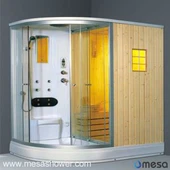



The hot-sale of shower rooms is driven by the life concept of dry and wet partitions. Nowadays, most family bathrooms in big cities use dry and wet partitions. However, in recent years, there have been many news about the self-explosion of shower room glass, which has discouraged many families. Three thousandths is the standard for the self-explosion rate of shower glass in our country. This means that if we unfortunately become the three of a thousand people, isn't it a tragedy? Therefore, some unscrupulous businesses began to create public opinion: the thicker the shower glass, the stronger its firmness. Many consumers actually believe it, thinking that the thicker the tempered glass, the better. Is this really the case?
Actually, this is not the case.
Although thick shower glass is stronger, its thermal conductivity is relatively poorer due to its thickness, and it is more likely to explode due to uneven heat dissipation.
The thicker the glass, the heavier the weight, which is also a "test" for the bearing capacity of hardware accessories. If the quality of the hardware used is not good enough to withstand this "pressure", it will be easily worn out, which will affect the service life of the shower room.
First of all, we have to figure out the question: Why does tempered glass explode?
That is because the spontaneous explosion of tempered glass is related to the impurity nickel sulfide contained in its raw material. The lower the content of nickel sulfide and the purer the glass, it means that the self-explosion rate will be lower. Although the nickel sulfide in the glass is invisible to the naked eye, it is not an easy task to make absolutely pure glass, and the cost will become very expensive and cannot meet the market demand. In addition, the spontaneous explosion of the shower room is related to many factors, such as improper installation, temperature, humidity, etc., will bring certain effects.
So, is the thicker the shower glass the better?
First of all, we have to affirm that the shower room glass is thicker, indicating that it is stronger, but if the shower room glass is too thick, it will also be counterproductive, because it is difficult for some small-brand shower room factories to fully temper glass with a thickness of more than 8mm. This will cause the shower room glass to have a sharp surface once it is broken, which will easily cause the risk of scratching the human body.
On the other hand, because the thicker the glass, the worse its thermal conductivity, so that the greater the possibility of glass bursting. Because one of the main reasons for glass spontaneous explosion is caused by uneven heat dissipation in various places, from this point of view, explosion-proof glass should be as thin as possible.
Furthermore, the thicker the glass, the heavier the weight, too much pressure on the hinges, the service life of the profiles and pulleys will be shortened, especially in the low-end shower rooms mostly use poor quality pulleys, so the thicker the glass, the more dangerous! The quality of tempered glass mainly depends on the degree of tempering, whether it is produced by a formal manufacturer, transmittance, impact resistance, heat resistance and so on.
A friend will ask, you have said so much, how thick is the tempered glass?
The shower room products on the market have semi-arc and linear shapes. The thickness of the glass is also related to the shape of the shower room. For example, the curved type has modeling requirements for glass, generally 6mm is appropriate, too thick is not suitable for modeling, and the stability is not as good as 6mm. Similarly, if you choose a linear shower screen, you can choose 8mm or 10mm specifications, but it should be reminded that as the thickness of the glass increases, the overall weight also increases, which has a greater impact on the quality of related hardware. High demands. But if you buy 8~10mm thick glass, the pulleys must be of better quality.