


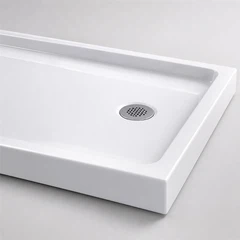



Most residential bathtubs hold around 40 to 80 US gallons when measured to the overflow, however that is not necessarily just how much water you use for a bath. A common 60-inch alcove bathtub usually falls near the lower half of that range, while deep freestanding, corner, jetted, and two-person tubs may hold 90 gallons or more.
The exact answer depends on the model, its interior shape, and what "capacity" means. For the most trusted number, check the manufacturer's specification sheet. If no specification is available, the measurement method below will offer you a useful estimate.

The Quick Answer: Average Bathtub Capacity by Type
The following figures are broad planning ranges, not universal product specifications.
|
Bathtub type |
Approx. capacity to overflow |
What to know |
|
Compact bathtub |
30-45 gallons |
Designed for little bathrooms; outside length alone doesn't determine capacity. |
|
Standard alcove bathtub |
40-60 gallons |
A usual range for lots of 60-inch residential tubs. |
|
Freestanding soaking tub |
45-90 gallons |
Deeper or wider models can exceed this range. |
|
Drop-in bathtub |
40-80 gallons |
Capacity varies substantially with the interior basin and deck design. |
|
Corner or garden tub |
60-100+ gallons |
Large footprints don't always equal better soaking depth. |
|
Walk-in bathtub |
40-80 gallons |
The user enters before filling, so fill time and water-heater performance matter. |
|
Jacuzzi or two-person tub |
70-150+ gallons |
Confirm the exact model capacity, filled weight, pump needs, and hot-water demand. |
One US gallon equals approximately 3.785 liters. For that reason, a 40-80-gallon tub represents about 151-303 liters at the stated capacity.
Why Bathtub Capacity Answers Vary So Much
Online answers can appear contradictory because they usually measure 3 various points.
1. Brim Capacity
This is the theoretical amount the shell could hold if filled to the leading edge. It is not a safe or realistic bathing volume because the water would spill when the bather entered.
2. Capacity to the Overflow
This is the water volume from the tub floor to the overflow opening. It is the most useful standardized figure on a product specification sheet, although the exact test method should still be verified with the supplier.
3. Actual Bath Fill
This is the amount used throughout a real bath. It is typically lower than overflow capacity because the water starts below the overflow and the bather's body displaces part of it. Different users can therefore use different amounts of water in the same bathtub.
The practical lesson is simple: use overflow capacity for product and installation planning, but use actual fill volume for estimating household water and energy use.

How to Calculate How Many Gallons Your Bathtub Holds
Method 1: Check the Specification Sheet
Look for "water capacity," "capacity to overflow," or "water volume." This is more dependable than estimating from the tub's advertised exterior length and width.
2 60-inch tubs can have various capacities because of wall thickness, backrest angle, rim width, and basin shape.
Action the within the tub - not the outdoors covering.
1. Measure the indoor length and size at the intended waterline.
2. Step the interior size and size near the bathtub flooring.
Method 2: Estimate from Interior Dimensions
Measure the inside of the tub - not the outside shell.
- Measure the interior length and width at the intended waterline.
- Measure the interior length and width near the tub floor.
- Average the two length measurements and the two width measurements.
- Measure the water depth from the tub floor to the bottom of the overflow opening.
- Use this formula:
Approximated gallons = average interior length x average interior width x water depth / 231

Use inches for all measurements. There are 231 cubic inches in one US gallon.
For example, suppose the average interior length is 48 inches, the average width is 21 inches, and the depth to the overflow is 12.5 inches:
48 x 21 x 12.5 / 231 = about 54.5 gallons
This remains an estimate. Curved corners, sloped walls, seats, lumbar supports, and jet components reduce usable volume. For an irregular tub, the specification sheet or a direct measurement is more accurate.
Method 3: Measure Your Actual Bath Fill
If your goal is to approximate water use rather than maximum capacity, note your water-meter reading, fill the bathtub to your normal level with no other fixtures running, and check the meter again. The difference is your practical fill volume.
A tap flow-rate test multiplied by fill time can also provide an estimate, however changing pressure and mixed-water flow can minimize accuracy.
What Determines Bathtub Water Capacity?
Numerous tubs with the same exterior dimensions can hold very different amounts of water. The major variables are:
- Interior dimensions: Wide rims and thick walls reduce basin volume.
- Soaking depth: Measure from the bathtub floor to the overflow, not to the leading rim.
- Basin shape: Straight walls generally preserve more volume than heavily tapered or sculpted walls.
- Backrest and seat design: Ergonomic contours improve comfort but occupy space inside the shell.
- Overflow position: A lower overflow limits the usable water level.
- Jets and fittings: Whirlpool components might alter interior volume and establish a minimum operating waterline.
- Bather displacement: The amount needed for a comfortable soak changes with the user and bathing position.
Capacity is therefore not a quality score. A well-designed 50-gallon tub might offer a better soak than a poorly shaped 70-gallon model. Soaking depth, back support, usable interior length, entry height, and drain placement should be evaluated together.
Why Capacity Matters Before You Buy or Specify a Tub
Hot-Water Availability
Do not compare bathtub capacity only with the storage size printed on a water heater. A bath uses a mixture of hot and cold water, while water-heater performance also depends on recovery rate and first-hour rating. ENERGY STAR guidance recommends following applicable plumbing-code needs and manufacturer sizing guidance.
For a rough planning estimate:
Hot-water fraction = (desired bath temperature - cold-water temperature) / (heater temperature - cold-water temperature)
If a 45-gallon bath is filled to 105°F, incoming water is 55°F, and stored hot water is 120°F, the theoretical hot-water requirement is about 35 gallons.
Pipe losses, simultaneous household demand, and heater recovery can increase the required margin. Have the installer verify the last system, and never raise the heater temperature solely to compensate for an oversized bathtub because of scalding risk.
Filled Weight and Floor Support
Water weighs roughly 8.34 pounds per US gallon, according to the U.S. Geological Survey. Sixty gallons alone weighs about 500 pounds.
Add the empty bathtub, one or more bathers, and any surrounding structure when assessing the installation. Large tubs - especially on upper floors - might require review by a qualified contractor or architectural professional.
Fill Time and Operating Cost
A bigger tub takes more time to fill and generally requires more water and energy to reach the same temperature.
Fill time can be estimated by dividing the actual fill volume by the tap's delivered gallons per min, but household pressure and simultaneous fixture use can change the result.
Project and Market Fit
For distributors, contractors, and hotel or apartment projects, capacity affects more than the user experience. It can influence hot-water-system design, floor loading, plumbing coordination, operating cost, and the suitability of a model for the target market.
A useful product submittal ought to state the capacity definition, overall dimensions, soaking deepness, empty weight, drain and overflow information, and installation requirements.
Does a Bath Use More Water Than a Shower?
Generally, a short shower uses less water than a full bath - but compare actual usage, not a bathtub's brim capacity.
The U.S. Environmental Protection Agency states that a standard showerhead uses 2.5 gallons per minute, while a WaterSense-labeled showerhead uses no more than 2.0 gallons per minute. That means a 10-minute shower uses about 25 gallons with a standard showerhead or up to 20 gallons with a WaterSense model.
Shower water use = showerhead flow rate x shower duration.
Shower water use = showerhead flow rate x shower duration
A long shower can use more water than a modest bath, while a deep soaking tub usually uses more than a brief shower. The fairest comparison is your tub's measured fill volume versus your shower's tested flow rate and actual duration.
How to Choose the Right Capacity
Before selecting a bathtub, ask 5 questions:
- What are the model's capacity to overflow and usable soaking depth?
- Will the interior length, width, and backrest suit the intended users?
- Can the water heater deliver the required mixed-water volume?
- Can the floor safely support the tub, water, bather, and installation materials?
- Is the model appropriate for the room layout, target market, and maintenance plan?
For purchasers contrasting MESA acrylic freestanding tubs, multiple sizes, shapes, colors, and configurations are available for residential, hospitality, retail, and project applications.
Confirm the exact capacity and technical data for the picked model rather than applying one average figure to an entire product category.
Conclusion
Most residential bathtubs hold roughly 40 to 80 gallons to the overflow, while compact tubs might hold less and large soaking, corner, jetted, or two-person models might exceed 100 gallons. Actual bath water use is lower and relies on the fill level and bather displacement.
For the right answer, identify the capacity definition first, then check the model spec. When planning a purchase or project, think about the water heater, filled weight, soaking depth, plumbing, and user comfort - not gallons alone.
FAQs
How many gallons does a standard bathtub hold?
Numerous standard 60-inch alcove bathtubs hold about 40-60 gallons to the overflow. The model specification is more reliable than a category average.
Does every 60-inch bathtub hold the same amount?
No. Wall thickness, rim width, basin taper, backrest angle, and overflow height can all change the capacity.
How much water is used in an actual bath?
Usually less than the stated overflow capacity. The exact amount depends on the fill level and body displacement; a water-meter reading provides the best household estimate.
How do I convert bathtub gallons to liters?
Multiply US gallons by 3.785. For example, 50 US gallons is roughly 189 liters.
Do I need a larger water heater for a soaking tub?
Perhaps. Compare the expected mixed-water fill with the heater's first-hour rating, recovery performance, and other simultaneous demand. Ask the installer to verify the last sizing.
Explore Bathtub Options
Discover MESA Acrylic Freestanding Bathtubs or contact the MESA team for model specifications, capacity data, and project sourcing support.


